
Invoice agent
Reads invoices and delivery notes and checks them against what was ordered.
See it in FormosaAI agents for businesses
The example is Grupo Maré: four restaurants, a central kitchen and 62 people. Six agents handle the repetitive work and call someone when a decision is needed.
Watch the day go byBy Gonçalo Rodrigues · updated November 2026
This is an example. Every business is different, and so are the agents. The names, companies and figures on this page are made up.
An agent is a program that handles one task from start to finish. It receives something (an invoice, a message, a number), works out what it is, does the work and tells whoever needs to know.
Invoices, delivery notes, messages, emails and the day's numbers.
Checks, merges, compares, records and prepares drafts.
What went well is simply done. What needs a decision reaches your phone.
The agent starts working on its own, when the invoice or the message arrives.
The agent makes sense of what arrives untidy, like a crumpled invoice or an order typed in a hurry on WhatsApp.
An agent only works well with tidy information. So the move happens step by step, and each step already pays off on its own.
Move from paper, spreadsheets and WhatsApp to one place, built around the business.
Invoices, orders and numbers read automatically, with alerts when something looks out of the ordinary.
Prepare orders, reminders and rotas, record what comes in and ask for a decision when one is needed.
You do not have to start at the first one. In our first conversation we work out which step you are on.
Ten moments from an ordinary day. Where the agent asks for a decision, try the buttons: this is how it reaches the phone of whoever decides.
Merged the orders from the four restaurants for the central kitchen: 14 WhatsApp messages and 3 emails, in one list.
An order from Cascais says 40 kg of salmon. The usual is 4 kg. Which is it?
Read the morning's 23 invoices and delivery notes. 22 match what was ordered.
The delivery note from Frutas Lima is 3 crates of lemons short. The complaint email is ready.
Summary sent to Rui: yesterday's sales were €6,840, 4% up on last Tuesday. Staff costs came to 31% of sales.
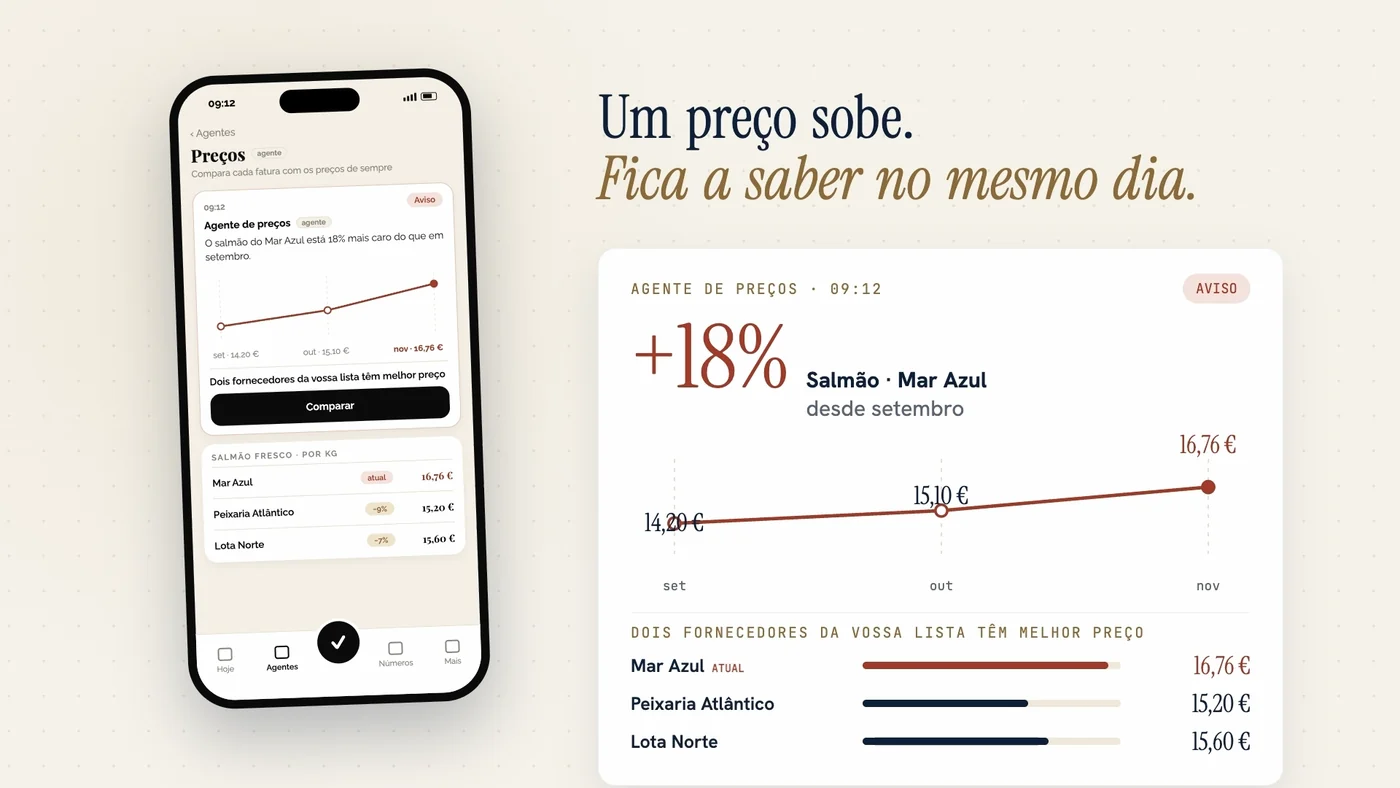
Salmon from Mar Azul is 18% dearer than in September. Two suppliers on your list have a better price.
Ana has let us know she is not coming in to the Alvalade restaurant. Marta and João are free and have the right training. The message to both is ready.
Three catering invoices fell due this week, €4,920 in total. There is a reminder ready for each customer.
€2,300 came in by bank transfer. Two invoices were marked as paid.
The day's hours are recorded across the four restaurants. Three people go over 40 hours this week if they work Friday's shift.
You have not decided anything yet: the four requests are still waiting.
Each one handles one task. They all work on the same information, inside the same system, and you can see each of them at work in one of the examples.
Reads invoices and delivery notes and checks them against what was ordered.
See it in FormosaWatches prices and margins and flags when a supplier goes up.
See it in FormosaReads orders sent by WhatsApp and email and prepares the order.
See it in RondaHandles absences, shift swaps and hours.
See it in TEMPOPrepares payment reminders and records what comes in.
See it in PrumoWrites the morning summary and answers questions about the business.
See it in TEMPOStills from the teaser, which is in Portuguese. The names, companies and figures are made up.


You are in charge of the agent. Trust is earned task by task, and some things always stay with a person.
The agent prepares and you confirm with one tap.
For example, marking invoices as paid when the money comes in.
Payments, messages to customers and pricing decisions always need a person.
Think of a task that keeps coming back: keying in invoices, merging orders, building the rota. Put in your own numbers and see what it adds up to in a month.
In a year: 320 hours and €3,840.
These are example figures: put in your own. An agent does not remove all of it, because someone always checks, but it shows the order of magnitude.
See this in my businessFour steps, always with me. You only go on to the next one if the previous one made sense.
You tell me how an ordinary week goes in your business: who does what, with which tools and where most time is lost.
A list of the tasks an agent can take on, ranked by impact in hours and in money. It is the work I have done for almost 7 years with companies at NOVA SBE: understanding the business before changing it.
Within a week at most, with your names, documents and rules. You try it before deciding anything at all.
The agent works alongside whoever already does the task. You only move to the subscription if it makes a difference.
A program that handles one task from start to finish: it reads what arrives, does the work and tells you when it needs a decision.
The aim is to take the repetitive work off their hands. Someone who spent the morning keying in invoices now checks the few the agent flags and deals with what really needs a person.
In most cases, yes. The agent can read what that software exports (files, emails, reports) or bring several programs together into one system. We look at that in the first conversation.
It will, just as a person does. That is why it always starts with someone approving, and every agent shows where each number came from. Only what always goes well becomes automatic.
Each company has its own system, separate from the others. The agents only see what they need for the task, and nothing leaves without approval.
A monthly subscription, with no large upfront fee. The price depends on what the agent does and is agreed after you have tried the prototype.
The first prototype arrives within a week at most. The time until daily use depends on what the agent has to do and is agreed with you before going ahead.
Tell me how an ordinary week goes. In 20 minutes you will know where to start.